A Baffling Message 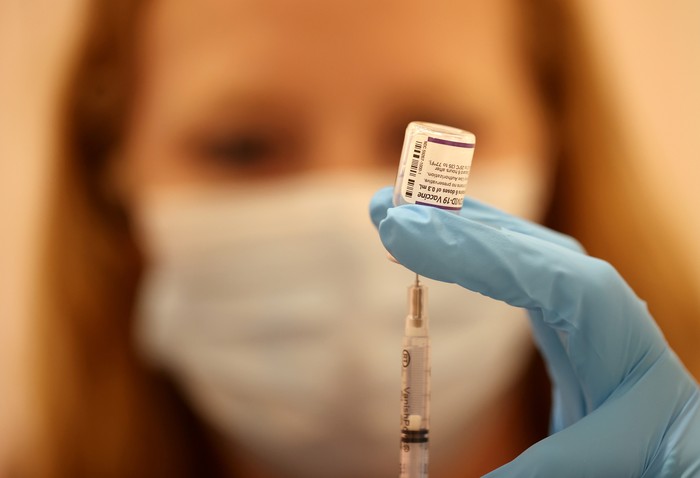 A pharmacist fills a syringe with the Pfizer COVID-19 booster vaccine in 2021. (Justin Sullivan / Getty) | View in browser Isabel Fattal: You recently wrote about how the timing of the latest COVID-19 booster rollout has serious pros and cons. How so? Katherine J. Wu: There's a lot that's worth celebrating. We are getting these boosters possibly as early as next week, and right now BA.5 is still the dominant coronavirus subvariant in the U.S. The vaccines include ingredients that are going to teach people's bodies to recognize and fight off BA.5. It's going to be the first time since the beginning of the vaccine rollout that we have a shot that is really well matched to the virus that's circulating. That's a huge win. The downside is that the vaccines are coming right after a big, sweeping update to the CDC's COVID guidelines. There's been a huge loosening of pandemic protections. Now there are very few things standing between us and the virus. Vaccines are super important, but they can't do this job alone. There's still a ton of virus around, and we know that vaccines, as good as they are, can't prevent all infections. They can't totally prevent long COVID. By telling the public that it's no longer necessary for most people to take additional protective measures against infection, the CDC is putting enormous pressure on vaccines. It's also a baffling message to send to people: You don't have to do anything about COVID, except please go get your booster urgently. It doesn't totally square. Isabel: Is there a clearer way to explain to people who are eligible to get this booster why they should do so? Katie: The tricky thing about vaccine uptake is that, in the same way that not everyone has the same reason for not getting a vaccine, not everyone has the exact same reason for getting a vaccine. So convincing people to get on board with this is going to be complicated. I do think there's going to be a huge wave of people who are like, Inject it straight into my eyeballs; I'm ready for this. But those aren't the people I'm worried about. People have spent this entire year hearing the message that things are so much safer now, COVID-wise. The incongruity here is, So why do I need this booster? I thought you said I was good. That's not to say that we should talk about COVID like a five-alarm fire, and imply that the pandemic is as bad as it was in 2020. We shouldn't, and it's definitely not. But maybe a better way to approach this would be to routinize all of the various protections we've come to adopt. The virus is still here; it's still presenting a significant threat. It may not be as bad as it was, but we need some layered protection strategies to minimize its impact on our lives. Something I've talked to people about over the past couple years, regarding vaccines, is: What if we don't frame it as a booster? That word has become really charged. We don't really call the annual flu shot a "booster." We update it as the virus mutates. What if we did the same thing here and said "This is our annual COVID shot"? Isabel: This will probably be America's last free COVID-19 shot. Can you talk a little about why that's the case, and what it means going forward? Katie: The vaccine's commercialization means that the government no longer has to foot the bill, taking some of the pressure off of it financially. But it's also a political move that allows the administration to say, essentially, "We no longer have to foot the bill. We won; we did it." If we are switching out of emergency mode and pivoting to the typical medical model, then everything is normal. Which gets to the second part of your question, which is a big worry. With commercialization, future shots will probably have to be covered by insurance companies. That means vaccines will still be available to those with the most privilege—both socioeconomically and otherwise—to seek out medical care, to access medical care, to go to a pharmacy, and to wait in line for these vaccines. But the people who are often most vulnerable to the virus will end up getting the least protection against it. Isabel: Finally, let's talk a bit about the CDC. Director Rochelle Walensky recently acknowledged that the organization made big mistakes in its handling of the pandemic, and that it needs to be retooled. How did the CDC get to this point? Katie: The main issues pointed out here were that the CDC acted too slowly and didn't make data available to the public quickly enough. When they did issue guidance, it was confusing, and people lost trust in the agency. We also know that the Trump administration did meddle in the development and the rollout of CDC guidance. The CDC has been siloed as a very research-focused institution. The organization was geared toward the slow-moving, step-by-step academic form of science that probably works fine not in times of crisis. But during a pandemic, when people need to know what to do as quickly as possible, and their lives are on the line, it might be less successful. Those are some gaping issues, and I applaud the CDC and Walensky for recognizing those issues and calling for a revamp. And there are other issues worth addressing that we haven't heard enough about. As I see it, it's not just that guidance has been confusing or too slow, but also that it has been so individually minded. You monitor your own risk; you worry about your own health. That is not going to work in the context of infectious disease, and it's not very well minded toward public health. Related: | 






 (The Atlantic)